Blindfold Baseball: Red Sox Lose to Reds, CB Bucknor Wins the Night
Boston battles back, ties it late… then hands the game—and the spotlight—to chaos in extra innings
If you were looking for a clean, well-played baseball game… congratulations—you watched the wrong one.
The Red Sox dropped a 6–5 extra-inning loss to the Cincinnati Reds in a game that had everything: sloppy execution, late-game hope, wasted opportunities… and a strike zone that appeared to be determined by a Magic 8 Ball.
Let’s not sugarcoat this: the Red Sox didn’t just lose this game—they participated in losing it. There’s a difference. And if you watched all 11 innings of this circus, you felt it.
Same Script, Different Night
Boston continues to treat the early innings like a suggestion.
Down 3–0 almost immediately, the Sox once again forced themselves into comeback mode before most fans had settled into their seats. It’s becoming a personality trait at this point. Why start strong when you can spend the entire night chasing?
Trevor Story tried to inject life with a home run, and to his credit, he did something. The problem is, with Story, it’s always a coin flip—home run or strikeout, hero or headache. There is no middle ground. It’s baseball’s version of Russian roulette, except the chamber is loaded with whiffs.
Meanwhile, the Reds did what competent teams do: they took advantage of opportunities. A little here, a little there, and suddenly Boston is staring up again, wondering how things got out of control.
Welcome to the “Gray Area”
Sonny Gray didn’t dominate. He didn’t implode. He just… existed in that uncomfortable middle space where you’re never quite sure if he’s about to shut you down or unravel completely.
The Sox had chances. Traffic on the bases. Moments where a big hit flips the game.
And every time? Just enough failure to keep Gray afloat.
It’s the ultimate illusion—he looks hittable, feels hittable… and yet somehow walks away without the game blowing up on him. That’s the “Gray Area.” And the Red Sox lived in it all night.
Hope Arrives… Right on Schedule
To their credit, Boston fought.
Roman Anthony chipped in. The lineup scratched across runs. And then in the ninth inning—just when you were ready to shut it off—Wilyer Abreu delivers the big swing to tie the game.
And for a brief, irrational moment, you believed.
You believed this was the turning point. That this was the game good teams steal on the road. That maybe—just maybe—this team had some backbone.
That feeling lasted about five minutes.
Extra Innings: Where Offense Goes to Die
Automatic runner on second. Multiple innings. Endless opportunity.
And what did the Red Sox do with it?
Nothing.
No situational hitting. No productive outs. No sense of urgency. Just strikeouts, weak contact, and the baseball equivalent of shrugging your shoulders.
It was less of an offensive approach and more of a passive surrender.
Meanwhile, the Reds did the bare minimum—and that was enough. Because against this version of the Red Sox, “bare minimum” might as well be elite execution.
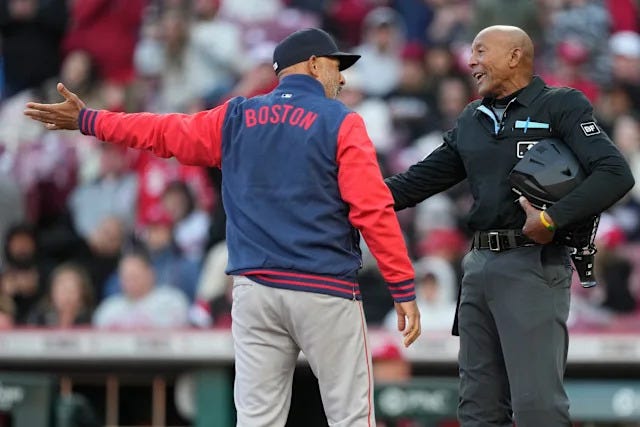
CB Bucknor: The Main Character
Let’s talk about it.
CB Bucknor didn’t just umpire this game—he hosted it.
The strike zone changed inning to inning, pitch to pitch, mood to mood. You had hitters freezing on strikes that weren’t strikes, swinging at pitches they didn’t trust, and pitchers visibly losing their minds.
Even the ABS challenges—meant to fix bad calls—turned into a highlight reel of just how inconsistent things were.
At one point, it felt like both teams collectively agreed:
“We have no idea what’s happening, let’s just guess.”
Alex Cora getting ejected? I’m surprised it took that long.
This wasn’t just bad umpiring. This was performance art. And unfortunately, everyone else on the field was forced to participate.
The Bigger Problem
Here’s the uncomfortable truth:
This game wasn’t lost because of one moment. Or one call. Or one inning.
It was lost because this team:
Falls behind early
Wastes scoring opportunities
Lacks a consistent offensive approach
Can’t execute in high-leverage situations
The comeback? Nice. The fight? Appreciated.
But good teams don’t need to “fight back” every single night. They show up ready. They execute. They finish.
The Red Sox, right now, do none of those consistently.
Final Thought
This is who they are—at least right now.
A team that keeps you watching… just long enough to be disappointed.
A team that flashes just enough talent to be dangerous… mostly to themselves.
And a team that, apparently, can survive nine innings… but has no idea what to do with a tenth.
Subscribe to Red Sox Digest.
Because if this is how the season is going to go, you’re going to need someone to laugh about it with.


