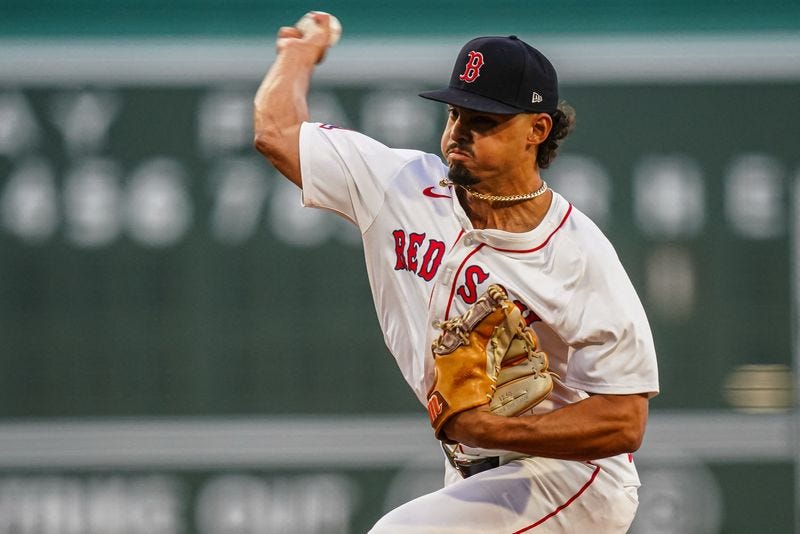
The Jordan Hicks Trade Fiasco: How the Red Sox Paid Millions, Burned a Prospect, and Still Got Nothing
Another Chapter in Boston’s Ongoing War on Its Own Farm System
There bad trades.
There are panic trades.
And then there are Red Sox payroll-driven, self-inflicted, spreadsheet-approved disasters — the kind where ownership saves money, fans lose years off their lives, and the baseball return is a polite shrug.
Welcome to the Jordan Hicks Experience. Again. Somehow.
Because if you thought the Rafael Devers trade was done wrecking things, congratulations — you underestimated John Henry’s ability to turn one bad decision into a recurring subscription.
This Is Still the Devers Trade. Yes. Still.
Let’s be clear right out of the gate: this isn’t really about Jordan Hicks. He’s just the receipt.
This is the aftershock trade. The lingering concussion. The “wait, why are we still bleeding assets?” phase of the Rafael Devers deal — a transaction that was supposed to “reset the organization” and instead reset the fanbase’s blood pressure.
Last June, Boston blew up the face of the franchise and told us all to relax because flexibility was coming. Payroll freedom. A smarter future. Baseball adulthood.
Fast-forward to February and the Red Sox are:
Paying $8 million in cash
Dumping a Top-5 pitching prospect
To make Jordan Hicks slightly less expensive to not pitch here
That’s not flexibility. That’s lighting money on fire and asking MLB Pipeline to help you clean it up.
The Trade, Stripped of PR Nonsense
Here’s what actually happened, without the spin cycle:
The Red Sox sent Jordan Hicks and David Sandlin to the White Sox
They received Gage Ziehl, a fine, anonymous pitching prospect
Boston included $8 million just to make the math palatable
Result: only $4 million of Hicks’ salary hits the luxury tax
So in one move, Boston:
Paid most of Hicks’ contract anyway
Gave away a pitcher who throws 100 mph
Got a prospect nobody was losing sleep over
Bragged internally about “clearing flexibility”
That’s not roster construction. That’s a balance sheet maneuver wearing a baseball uniform.
Jordan Hicks: The $12 Million Optical Illusion
Remember when Hicks arrived and we were told he was:
A weapon
A power arm
A bullpen stabilizer
A possible starter
A thing that totally justified the Devers trade?
Turns out he was mostly:
Inconsistent
Expensive
Unreliable
And eventually a problem that required cash to remove
The Red Sox didn’t trade Hicks because the White Sox desperately wanted him. They traded Hicks because Boston desperately needed him gone.
That’s an important distinction.
If you have to attach $8 million and a Top-5 pitching prospect to move a reliever, you didn’t “reallocate resources.”
You admitted failure and paid a convenience fee.
David Sandlin: 100 MPH, Gone for Accounting Reasons
This is the part that should make your eye twitch.
David Sandlin wasn’t some throw-in. He wasn’t a lottery ticket. He wasn’t a “maybe.”
He was:
Ranked Top-10 in the system
Top-5 among pitchers
Touching 100 mph
Armed with a fastball, slider, and splitter that could embarrass hitters
Yes, he had command issues. Yes, he had reliever risk.
You know who else has reliever risk? Most pitchers.
The Red Sox didn’t trade Sandlin because he failed.
They traded him because he was valuable enough to make the money work.
That’s it. Full stop.
And if that doesn’t sum up the modern Red Sox, nothing does.
“But They Cleared 40-Man Spots!”
Ah yes. The rallying cry of the defeated front office.
Two 40-man roster spots are now open. Tremendous.
For whom?
What impact bat?
What meaningful move?
Because if the answer is “flexibility,” congratulations — we’ve been flexible since 2020 and the lineup still hits like a Triple-A bus ride.
Clearing roster spots only matters if you use them.
Right now, this feels like rearranging deck chairs while telling fans to admire the spacing.
The Luxury Tax Boogeyman Strikes Again
This trade wasn’t about baseball.
It was about ducking thresholds.
Boston didn’t want Hicks’ full salary counting.
They didn’t want to creep toward another surcharge.
They didn’t want to explain to ownership why money was being spent without wins attached.
So instead:
They paid $8M anyway
Lost a high-octane arm
And pretended the problem was solved
That’s not competitive strategy. That’s tax avoidance cosplay.
“I Told You So” Section (Mandatory Reading)
This was always going to happen.
The second the Devers trade was framed around payroll instead of players, the ending was written:
Short-term fixes
Mid-term confusion
Long-term asset bleed
Jordan Hicks was never the centerpiece. He was a placeholder.
Sandlin is the cost of pretending otherwise.
And now the Red Sox are left with:
Less depth
Less upside
Less credibility
And the same unanswered questions at the plate
Final Thought: This Is What Drifting Looks Like
This isn’t tanking.
This isn’t contending.
This isn’t even rebuilding with conviction.
This is drifting.
Paying to undo your own moves.
Trading talent to fix accounting problems.
Calling it strategy and hoping spring training optimism fills the gap.
Jordan Hicks is gone. David Sandlin is gone.
The money is mostly gone.
The plan? Still missing.
And somehow, we’re supposed to clap because the spreadsheet looks cleaner.
Subscribe to Red Sox Digest — because somebody has to keep the receipts.


I think you could make the case that this fiasco started with Mookie Betts. After they got pennies on the dollar for the best homegrown star since (Clemens? Boggs? I gotta be forgetting someone), the fanbase (rightfully) sharpened their pitchforks, management overpaid a talented hitter who offered little on defense and would be a full time DH by the midpoint of the deal at the latest. Then, when Casas got hurt, they alienated their would be face of the franchise, the one they only paid in order to placate their fans, by changing his position without even a discussion. If I was a Red Sox fan, daydreams of a coup d’état would never leave my head.